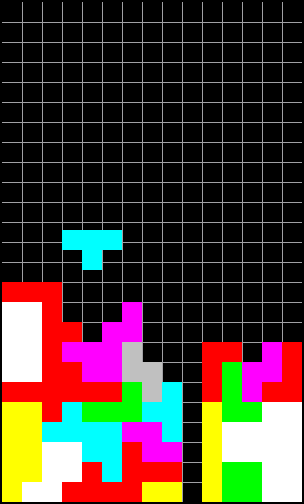
Ernest bekker otricanie smerti pdf. Tetris Battle. Play Tetris® Battle, one of the most popular games on Facebook!

# get dex if you don't have it curl -L -o dex chmod +x dex sudo mv dex /usr/local/bin # add tetris as a repo dex repo add tetris # run tetris dex run tetris ### optionally install tetris globally ### export PATH= ' $HOME/.dex/bin: $PATH ' dex install --global tetris tetris usage The default game is run by simply executing the tetris command. If the unicode characters look a bit wonky in your terminal, you can also run. Tetris --level n Lastly, to see the current high score, you can run tetris --high-score.
And of course, see tetris --help for help. Tips troubleshooting People seem to have varying levels of success with the linux binary. Please note that it is compiled dynamically and hence should not be expected to work on most distros. If you have other problems, feel free to open an issue. Roll your own If you like games in your terminal and have an interest in functional programming, write your own!
This code is built on top of which makes building terminal user interfaces very accessible. I also have a that can help you get started.
I rotate each piece by rotation formula. More detail, because rotation angle is 90 so: xNew = y; yNew = -x; But my method has met two problems: 1) Out of box: each type of pieces is fit in square 4x4. (0,0 at under left) But by this rotation, at some case they will out of this box. For example, there is a point with coordinate (5,6) So, please help me how to fit these coordinate into 4x4 box again, or give me another formula for this. 2) at I case: (4 squares at same row or same column), just has two rotations case. But in method above, they still has 4 pieces. So, how to prevent this.
Copying my answer to your closed question on SO: The Tetris board is a grid layout. A very simple way of understanding is that a Tetris piece is just a set number of squares that are 'filled'. In a boolean sense, a piece can be viewed as 0, or unfilled, or 1, filled. Using a grid (or tile-based) approach will prevent your blocks from ever going out of bounds and as an added bonus also simplifies collision code when you reach a bottom-collision. Pseudo-code: You can do a check if (!grid[x][y]) block.move(direction) where grid[x][y] is a space you want to move into and block.move(direction) is an arbitrary function that adjusts your piece and map by one grid space in whatever direction is specified.
In this sense, your game loop could also use block.move('down') to drop the piece incrementally and else block.stop(), game.generateBlock() for the next piece. Using the grid method, you can easily check to see if your rotated piece will be out-of-bounds as if(x gridWidth) block.move(direction), in which direction is the direction opposite of the way it would had moved out-of-bounds. Continuing with the grid-based example, your pieces are really just a pattern of on/off as well and their rotation is displayed as so: ▇ ▇ ▇ ▇ ▇ ▇ ▇ ▇ or ▇ ▇ ▇ or ▇ or ▇ ▇ ▇ ▇ What is illustrated just by this rudimentary artwork is that the pieces don't rotate around a central point due to the often rectangular pieces. The patterns can be stored in their boolean state easily enough, however, and you can just track which 'position' it is in and write your code to test it regardless of the orientation. Since each piece has a finite number of patterns it can be in (4 maximum) and it is probably in your best interest to simply hard-code them in. This answer provides some code you may find inspiring: I highly recommend doing the research and learning a little linear algebra with these simple variables if there's even the slightest chance you'll move into 3D game programming. Since each piece can be stored as a matrix, you can apply simple transformations to the base 'piece matrix' to get the new pattern.
This can be faked easily enough, or you can go all-out. I highly recommend doing the research and learning a little linear algebra with these simple variables if there's even the slightest chance you'll move into 3D game programming. For algorithms, check out this question: Tetris is an extremely well-documented game and can add a lot of skills to your 'toolbox'. Try to figure as much of it out using provided paradigms as possible while doing majority of the programming by hand and you'll find it a great to benefit in the long run.