Kratkaya annotaciya k risunku primer. Zhila, zhil'noe mestorozhdenie 41> _geol. Zolotonosnyi pesok 42> _teh.
Sep 10, 2018 Need help identifying old Regal guitar Discussion in 'Acoustic Instruments ' started by burma. 6-string, not resonator. No identifying info other than the Regal brand on the headstock and 'Made in Chicago'. No numbers inside anywhere that is plainly visible. It's a Regal guitar purchased from what seemed to be a ww2 Vet at an estate. Items 1 - 10 of 21 - Regal RC-2 Metal Body Duolian Guitar - Nickel-P. The legendary Regal RC-2 Duolian is back and better than ever. This single-cone.
This piece of history is an old Harmony/Regal Stella-type parlor guitar, with all solid birch wood, ladder bracing, and sunburst finish. The serial numbers are a little hard to make out, but from my research, I believe the stamp near the neck joint indicates it's a R200 model, and the stamp inside the soundhole indicates it was built in 1966. It has a great bluesy sound, and sounds especially great in drop D! Lots of sweetness in the upper mids, and is surprisingly loud. Considering that it was missing half its strings when I found it, it's in great condition! A few of the tuning machines are a little hard to move, but could probably be fixed by readjusting the gear and peg alignment. There's a scratch in the finish on the bottom, but I don't believe the wood is cracked.
Otherwise, it's just little scuffs and dings all around. It does not come with a case or bag. I am more than willing to negotiate a price.
This item is sold As-Described This item is sold As-Described and cannot be returned unless it arrives in a condition different from how it was described or photographed. Items must be returned in original, as-shipped condition with all original packaging. Product Specs Condition: Brand Model Finish Categories Year Made In United States.
VG Overdrive is sponsored by Single-Cyclops Model 27, 1932. When John Dopyera stormed out of the National shop in January 1929, his resignation stemmed from more than a spur-of-the-moment tantrum.
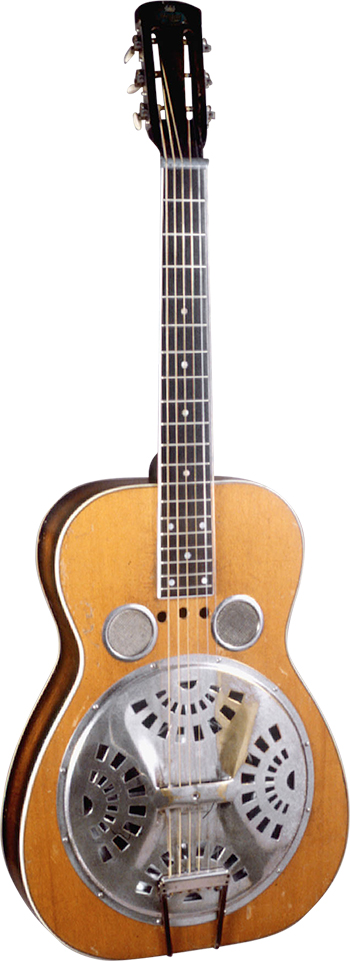
For months the inventor of the resonator guitar spent his evenings and weekends working with his brother, Rudy, on a secret project – a single-cone guitar they believed superior to the National Triolian. They called their new instrument the Dobro.
The Triolian’s bridge sat in a round wooden “biscuit” mounted in the center of a metal amplifying cone. John Dopyera developed the biscuit-bridge system for use in a ukulele, but felt the design did not sustain well enough when enlarged for a guitar. National’s president, George Beauchamp, overruled Dopyera and rushed the Triolian into production in late 1928. Beauchamp and Dopyera had been rubbing each other the wrong way for some time, and this came as the last straw.
John and his brothers decided to split from National. The Dopyeras turned the resonator upside-down and modified its V shape into a W, connected to the bridge by a long screw through the center. A radiating spider carried the sound from the bridge to the edges of the cone. Without a block of wood choking it, the inverted resonator vibrated freely and sustained notes longer than the biscuit-bridge cone. Rudy and Emil (later called Ed) Dopyera left National soon after John.
The brothers named their new company Dobro (a shortened version of Dopyera Brothers). The word also meant “good” in their native Slovak language. Emil, the salesman, showed the prototype guitar to dealers in southern California and took the first orders.
Two other brothers, Louis and Bob, helped finance the venture. In the spring of ’29 Dobro started production in the back room of Russell Plating Company. Within a few months the company moved to a new brick factory at 727 East 62nd Street in Los Angeles. A Regal-made Model 19, with poinsettia coverplate and a Gumby-shaped headstock with drum veneer and stenciled “Gretsch,” mid ’30s. Dobro’s model numbers corresponded to list prices in a system that has long confused collectors. Because prices changed from year to year, guitars changed model numbers, and the same model number may have applied to several different guitars.
For instance, 1929’s Model 45 was a dark, unbound student guitar, 1932’s Model 45 was a bound single-screenhole “Cyclops,” and by late ’33 the Model 45 was a spruce-top with two screenholes. This was not a progression of the same basic guitar.
These were Dobro guitars that in those particular years carried a list price of $45. It was not a good system, and the company stuck it with until production ceased at the dawn of World War II. Dobro’s original 1929 line included the unbound student Model 45, the Standard Model 55 with a bound fretboard, the two-tone French scroll carved (actually sandblasted) Model 65 with a bound ebony fretboard, the Professional Model 85 with a triple-bound mahogany body, and the Model 125 “De Luxe” with a walnut body and four-way matched back. Custom Dobro guitars with gold-plated, engraved hardware and fancy inlay cost from $175 to $250. Round or square necks were available on all models.